How it works
How does Steadi’s couch cup holder work?
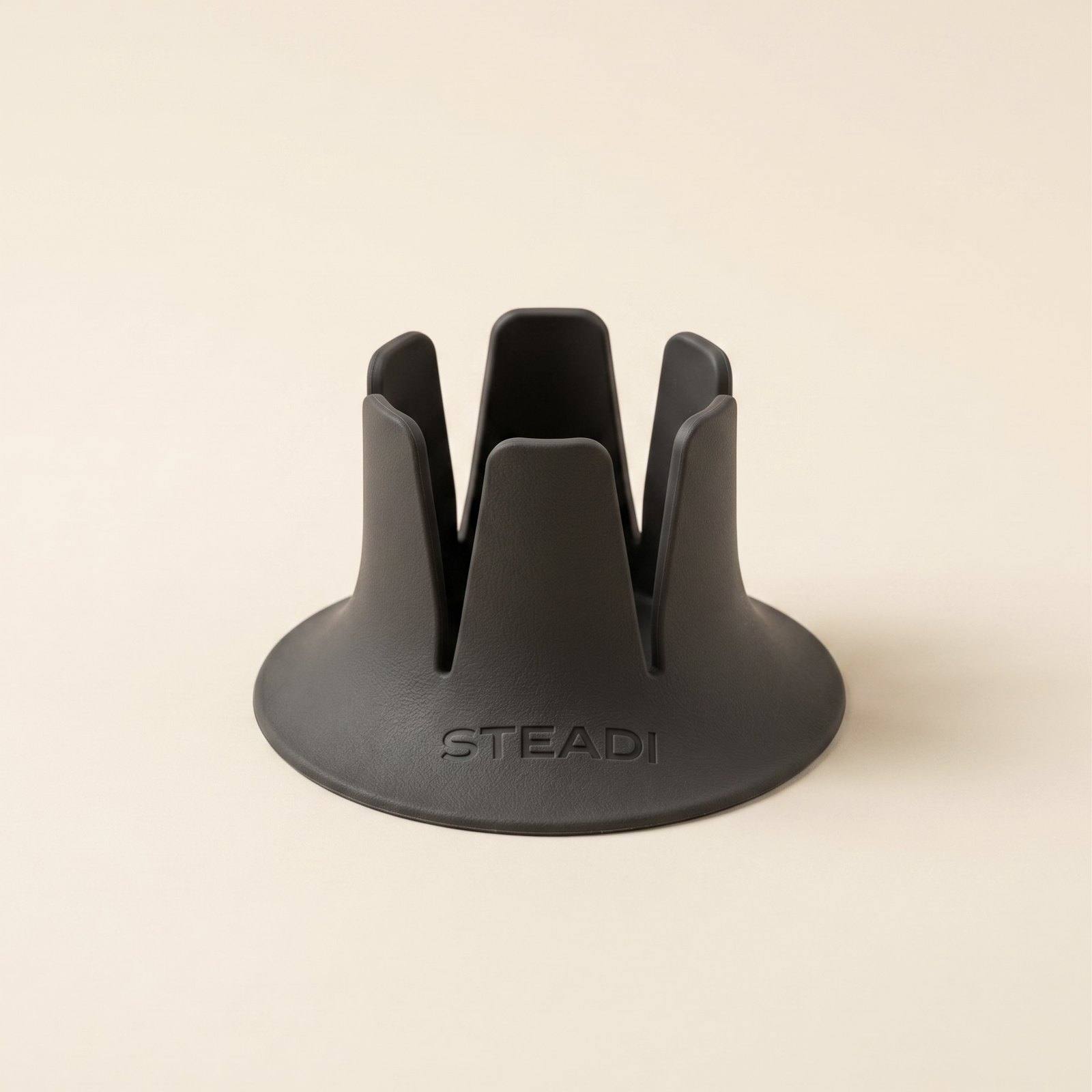
Steadi slips around the base of a compatible drink. Its flexible fins grip the container, and its wide base spreads support across more of the cushion. It helps resist tipping on a reasonably level, supported spot; it does not prevent every spill.
Explore the base, fins and movement ↓Why drinks can tip on a cushion
A cushion can compress unevenly beneath a drink. A narrow container base may sink or lean as the foam and fabric change shape. Someone sitting down or moving nearby can also shift the support beneath it.
A wider base can help distribute support, but it cannot level a slope or stop a cushion from moving. Choose a separate stable surface if the available spot cannot support the full holder.
The mechanism
One piece.
Base and flexible fins.
A wide base spreads the combined load over more of the cushion than the container’s base alone. That can help resist tipping, but the cushion can still compress or slope. A wider footprint does not make an uneven surface level.
Flexible fins hold the sides of a compatible container. Check that its base is 2–3.15 inches across, that any handle clears the fins, and that the container seats properly. Capacity alone does not establish fit.
The flexible fins allow some movement while supporting the container. How it responds depends on the drink, the cushion and the force applied. A hard knock, steep slope or shifting support can still cause a spill.
The part people don't expect
See it respond
on a real cushion.
Different holders are designed for different supports. A shelf or tray can provide a separate surface; Steadi rests on the cushion and moves with it. Movement still affects stability. Use a reasonably level spot with support beneath the full base.
Watch the product demonstration on the homepage. It shows one setup; your drink, cushion and placement can produce different results.

One piece, nothing to it
Steadi is one piece, with no assembly or installation. Hand wash only: rinse or wipe it clean and let it dry. Do not put it in the dishwasher. When moving it to another spot, check the container’s fit and the support beneath the full base again.
Give the full 5.2-inch footprint a reasonably level, supported spot. A hard knock, steep slope or shifting cushion can still cause a spill.
Where the shape works
Steadi fits container bases 2–3.15 inches across, inclusive. Measure the bottom with a ruler, not the rim or a sticky note, and check that any handle clears the fins. The exact 40 oz Stanley Quencher H2.0 is confirmed; other models need their own fit check. See the Steadi fit guide.
First use: check the drink, then choose its spot
- Start with an empty container on a firm surface. Measure across the center of its bottom. The confirmed base range is 2–3.15 inches, inclusive. Check that any handle clears the fins.
- Fit Steadi around the bottom. Confirm that the container seats properly. Stop if a handle interferes or the combination requires force; a diameter within range does not prove every shape fits.
- Choose full support. The holder’s 5.2-inch footprint needs a reasonably level, supported spot. Check the location while sitting in your normal position, before using a filled drink.
- Recheck when something changes. Different drinkware, wet surfaces or moving furniture can change the setup. Choose another stable surface if you cannot get suitable support.
Measure your drink · Choose a couch drink spot · Choose a bedside drink spot
If the holder slides or the fit changes
Upright does not mean anchored
Sliding and tipping are different movements. Steadi helps resist tipping by widening the drink’s base; it does not attach to your furniture. Check full, reasonably level support, wipe away moisture and reassess the spot. If it slides or its support changes as you move, choose a different stable surface.
If a container feels loose
Recheck the base measurement, shape and handle clearance, and inspect the holder for damage. Do not rely on a setup that does not seat properly. Send Steadi Labs the exact model, base measurement, photos and a description of what changed. If you switched from a larger container to a smaller one, include both models. We do not have a verified recovery-time or grip-restoration procedure to recommend.
If a container is difficult to remove
Empty it first and work on a stable surface. Do not yank or force it. Check the fit and handle clearance, and read the snug-container guidance. Contact Steadi Labs if it remains difficult to remove.
Cleaning after use
Hand wash only. Rinse or wipe Steadi clean and let it dry. Do not put it in the dishwasher. It is not a spill tray or waterproof barrier; follow your furniture or bedding manufacturer’s care instructions if liquid reaches the surface beneath it.
What the demonstrations show
The can on the couch
The homepage’s couch clip shows a red can in a light-colored Steadi on grey fabric cushions, with children moving nearby. It is one example of the holder responding to cushion movement. The clip does not establish how every cushion, drink or knock will behave.
Fitting and handling a can
The fitting clip shows hands putting a green Steadi around a can, lifting the combination and setting it on brown upholstery. It illustrates fitting and handling that particular can. It does not measure the fit of another container or compare performance across upholstery materials.
A demonstration is an example, not a controlled comparison. We do not publish measured impact forces, fill levels or repeat-trial results for these clips. Use them to understand the product’s form and handling, then check your own container and available support. They do not establish spillproof performance.
Now the easy part.
Pick a pack, give each one a color, and give everyone on the couch their own. $4.95 U.S. shipping, always.
Get yours — 2-pack $14.95Checkout is on steadilabs.com — Steadi Labs is the company that makes it.